
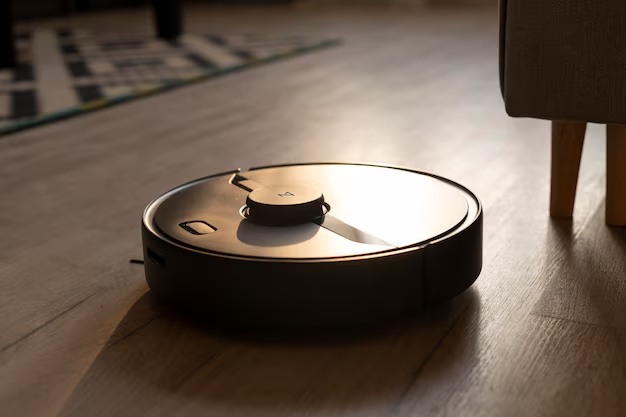
Household cleaning has evolved from manual sweeping to powerful upright vacuums, and now to smart robot vacuum cleaners that practically handle the work for you. These compact devices move around your home on their own, sucking up dirt, dust, and pet hair while you focus on more important tasks.
Robot vacuums have become a favorite for busy families, pet owners, and anyone who values convenience. They save time, fit into tight spaces, and many models can even map your home or connect to mobile apps for scheduling. But with so many designs, features, and price ranges available, choosing the right one can be overwhelming.
This guide will walk you through what to consider before buying, compare different types, share pros and cons, and provide practical insights from real experiences and expert opinions.
Devices | Features | Price |
|---|---|---|
Robot Vacuum Cleaner | 2800Pa Suction |
What to Consider Before Buying a Robot Vacuum Cleaner
Not every robot vacuum is built the same. Before investing, consider these essential factors:
1. Navigation System
- Basic models move randomly and cover areas inconsistently.
- Advanced versions use sensors, lasers, or cameras to map your home, cleaning more efficiently.
- Mapping vacuums are better for larger homes with multiple rooms.
2. Battery Life and Charging
- Battery runtime can range from 60 minutes to over 150 minutes.
- Look for models that automatically return to their dock when the battery is low.
- Larger homes benefit from longer battery life.
3. Suction Power
- Strong suction is needed for carpets and pet hair.
- Lower suction is fine for hard floors and light cleaning.
4. Dustbin Size
- Smaller bins require frequent emptying, which can be inconvenient.
- Some advanced units have self-emptying docks for minimal maintenance.
5. Smart Features
- App control, scheduling, and voice assistant compatibility add convenience.
- Some models allow “no-go zones” to prevent the vacuum from entering certain areas.
6. Noise Level
- Quieter models are ideal for apartments or households with children.
- Higher suction usually means more noise, so consider balance.
7. Floor Compatibility
- Some robots excel on hardwood floors, while others are better for carpets.
- Mixed flooring homes need versatile models with adjustable suction.
8. Maintenance Needs
- Check how easy it is to clean the brushes and sensors.
- Consider ongoing costs like filters or brush replacements.
Product Summary: Types of Robot Vacuum Cleaners
Robot vacuums fall into several categories, each designed to meet specific needs.
| Type | Best For | Pros | Cons |
|---|---|---|---|
| Basic Robot Vacuums | Small spaces, light daily cleaning | Affordable, simple to use | Random navigation, misses spots |
| Mapping Robot Vacuums | Large homes with multiple rooms | Efficient, systematic cleaning | Higher cost |
| Hybrid (Vacuum + Mop) | Homes with hard floors | Sweeps and mops in one pass | Less effective on thick carpets |
| Self-Emptying Robots | Busy households, minimal maintenance | Automatic bin emptying, very convenient | Bulky charging base, more expensive |
| Pet-Specific Models | Homes with dogs or cats | Strong suction, specialized brushes | May require frequent brush cleaning |
Pros and Cons of Robot Vacuum Cleaners
✅ Pros:
- Time-Saving: Automates cleaning so you can focus on other tasks.
- Smart Features: Many models can be scheduled or controlled via smartphone apps.
- Compact Design: Cleans under furniture where upright vacuums can’t reach.
- Good for Daily Maintenance: Keeps dust and dirt at bay between deep cleans.
- Pet-Friendly: Picks up hair and dander effectively with the right brushes.
❌ Cons:
- Higher Cost: Advanced models can be expensive.
- Not a Complete Replacement: May struggle with deep cleaning thick carpets.
- Maintenance Required: Brushes and bins need regular attention.
- Navigation Issues: Basic models may get stuck or miss areas.
- Battery Dependency: Needs recharging, which may interrupt cleaning.
Who It’s Best For
Robot vacuums are best suited for:
- Busy Professionals: Those with limited time for housework.
- Families with Kids: Helps manage crumbs and daily messes.
- Pet Owners: Keeps up with shedding hair and dander.
- Elderly Users: Offers hands-free cleaning with minimal effort.
- Small Apartment Dwellers: Compact and efficient for limited spaces.
Real Insights: Experiences and Expert Opinions
Many users appreciate robot vacuums for their ability to keep floors tidy with little effort. For instance, parents often highlight how useful these devices are for cleaning up after toddlers who leave trails of snacks. Pet owners report noticeable differences in managing fur, especially when scheduling daily runs.
Experts suggest pairing a robot vacuum with a traditional upright or canister vacuum for the best results. The robot maintains cleanliness, while a corded vacuum provides occasional deep cleaning.
Some users caution that while self-emptying models are convenient, the charging bases can take up significant space. Meanwhile, basic models work fine in smaller apartments but may not be efficient in large, multi-room homes.
FAQs About Robot Vacuum Cleaners
Q1. Can robot vacuums replace regular vacuums?
Not entirely. They are great for maintenance but may not handle deep carpet cleaning as effectively as traditional vacuums.
Q2. Do robot vacuums work well with pets?
Yes. Many models are designed with specialized brushes and strong suction to handle fur and dander.
Q3. How often should I empty the dustbin?
For standard models, after every cleaning or two. Self-emptying models reduce the frequency to once every few weeks.
Q4. Can a robot vacuum handle stairs?
No. Robot vacuums have cliff sensors to prevent falls but cannot clean staircases.
Q5. Are they noisy?
Most are quieter than upright vacuums, but noise varies by suction strength.
Q6. Do they work on all floor types?
Yes, most are designed for mixed surfaces, though performance varies. Hybrid models with mopping are ideal for hard floors.
Final Recommendation
Robot vacuum cleaners are one of the most practical innovations in home cleaning. They don’t fully replace traditional vacuums, but they save valuable time by handling daily dust, dirt, and pet hair automatically. For large homes, a mapping robot with long battery life is a smart choice. Smaller apartments can get by with basic models, while households with pets may benefit from pet-focused or self-emptying versions.
Ultimately, the right choice depends on your living space, flooring type, and cleaning habits. If you value convenience, time-saving technology, and a cleaner home with less effort, investing in a robot vacuum cleaner is a decision you won’t regret.